
Images by the author unless otherwise noted
To start, let me admit I’m learning. I have been a reloader for almost 50 years, loading mostly my home-spun cast bullets. It wasn’t really until fairly recently that I got into loading bottleneck rifle cartridges, where you all but fill the case with a slower-burning powder and must measure and weigh every charge.
That’s different than just cranking out 9mm/.38 Spl/.45 ACP target loads on a progressive or turret press. There, you are striving for powder weights within .1 grain, up or down. The powder weights you deal with at this low end of the reloading food chain are miles apart from the precision required by the rifle cartridge top end. I found out that I really enjoyed this little adventure into OCD-Reloading-Land. With the right equipment, it’s not hard and can be very satisfying. (I list the equipment I used below.)
So… what exactly am I loading? To be specific, the .277 SIG Fury and the .308 Winchester. Let’s look at each one, then we’ll discuss reloading them.
The 277 Fury is new. I am always about adopting new calibers and running with them, but I discovered a downside to that… they may be so new that data can’t be readily found. I did find some data (more below), but there isn’t a lot out there yet.
Two Effective Cartridges… An Overview
.277 SIG Fury
Both cartridge dimension images courtesy Lee Precision
I can hear many of you say, “the .308 I know… what in the world is the ..277 SIG Fury?” I can’t blame you. For a quick history of this cartridge, you can read my review of the Bear Creek Arsenal .277 SIG Fury AR here. Suffice it to say, for this article, the .277 SIG Fury was developed recently by Sig Sauer. It comes in two flavors… an all-brass-case, lower-pressure round, or an 80K-pressure version that uses a hybrid, stainless steel and brass case. I cannot reload that hybrid case, so I stuck with the all-brass version. Plus, I didn’t want to bend anything when I shot it through the AR.
This cartridge’s claim to fame is ballistics that outperform the .308 and 6.5 Creedmoor at longer ranges. You get more velocity and energy, and a flatter trajectory. Again, I lined that out in the previously-linked review.
The .277 is the civilian version of the 6.8×51 cartridge the Army is considering to replace the 5.56mm. Why? Penetration and flat trajectory. The 6.8×51 hybrid cartridge will penetrate Level III body armor at 500 yards. That feature was not needed when the 5.56mm first appeared, as most combatants did not wear body armor. That has changed; hence the stipulation.
Although the case looks like it was based on the .308, it isn’t. It IS very similar, especially in rim diameter (.408 vs. .409), overall length (2.825 vs. 2.810), and a couple of other measurements, but they are different animals. Of course, I’m talking about the all-brass .277 case, not the hybrid stainless/brass one that can contain the 80K pounds of pressure the full-bore .277 SIG Fury/6.8×51 can generate.
Those dimensions are similar, but we won’t do anything with the hybrid case here, just the all-brass version. But… don’t think the all-brass version is a weakling compared to its stainless-headed cousin. It still generates over 60K pounds of pressure. It is fully equal (at least) to other similar cartridges, and is gaining a reputation as an effective game cartridge for deer-sized or larger animals at longer ranges.
The .308
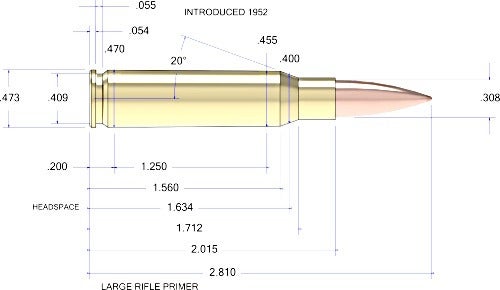
I think most readers are familiar with the .308. Appearing in the same year that I did (1952), it has earned a following among both civilian and military shooters. This is one of the rare cartridges that was adopted by the military from the civilian version. Known as the 7.62×51 NATO, this .30-caliber round is highly versatile. Suitable bullet weights range from around 125 grains to 200 grains. I like loading the 168-grain weight class… these make great deer stoppers and are inherently accurate. Plus, unlike the .277, reloading components (and loaded ammo, for that matter) are common and available wherever such things are sold.
The .308 is versatile. I don’t know of anyone who hunts varmints with it, but with the lighter bullets, you could. I mentioned deer… the .308 is great for that and similar game. I won’t go on, because I assume that most readers are familiar with this classic round.
Reloading Considerations
Reloading both cartridges is straightforward. I acquired a set of .277 dies from Lee Precision, and a set of .308 dies from RCBS. I listed links to everything I used to put this article together below.
The Lee die set is really interesting… they have upped their game. This set’s bullet seater is a micrometer affair, allowing you to precisely and repeatedly set the bullet seating depth. Even the box they sent them in was an improvement over past efforts. As usual, they include a shell holder with the dies.
The RCBS dies came in the familiar green box and are primo quality, as usual. The shell holder was ordered separately and was included in the package. I don’t know how many sets of RCBS dies I own, but there’s a bunch. I also have several Lee die sets. Both of these die sets will do a great job for decades if you take care of them.
Case Prep
One thing that we must be aware of is the case length and the general condition of the case. Two pieces of equipment can really help with this. One is an RCBS case trimmer, and the other is their Brass Boss. The trimmer is pretty self-explanatory… You will need to keep both calibers’ cases trimmed to their trim-to lengths of 2.015 in. It’s the same for both of them. I was shooting once-fired brass, so the trimming function wasn’t really necessary. As I shoot each case more, I will need to watch their length and trim as needed.
The Brass Boss is an interesting critter. I have several individual tools that will chamfer, true, and otherwise manipulate cases, but this thing has everything you need to do that in one spot. For everything from chamfering both inside and outside the case mouth to cleaning and truing primer pockets, this tool will get it done quickly. It is an indispensable item when preparing rifle cases for reloading.
Other Equipment
I mentioned case trim and prep tools, but what else am I using to complete this little reloading task? Here you go…
Press:
I own four progressive presses, but for bottleneck rifle cartridges, it’s single-stage all the way. You have total control with a one-at-a-time press, and you are not looking to load four zillion cartridges an hour. If we were talking pistol competition loading, I’d sure go the other way, but for precision rifle loading, the single-stage wins.
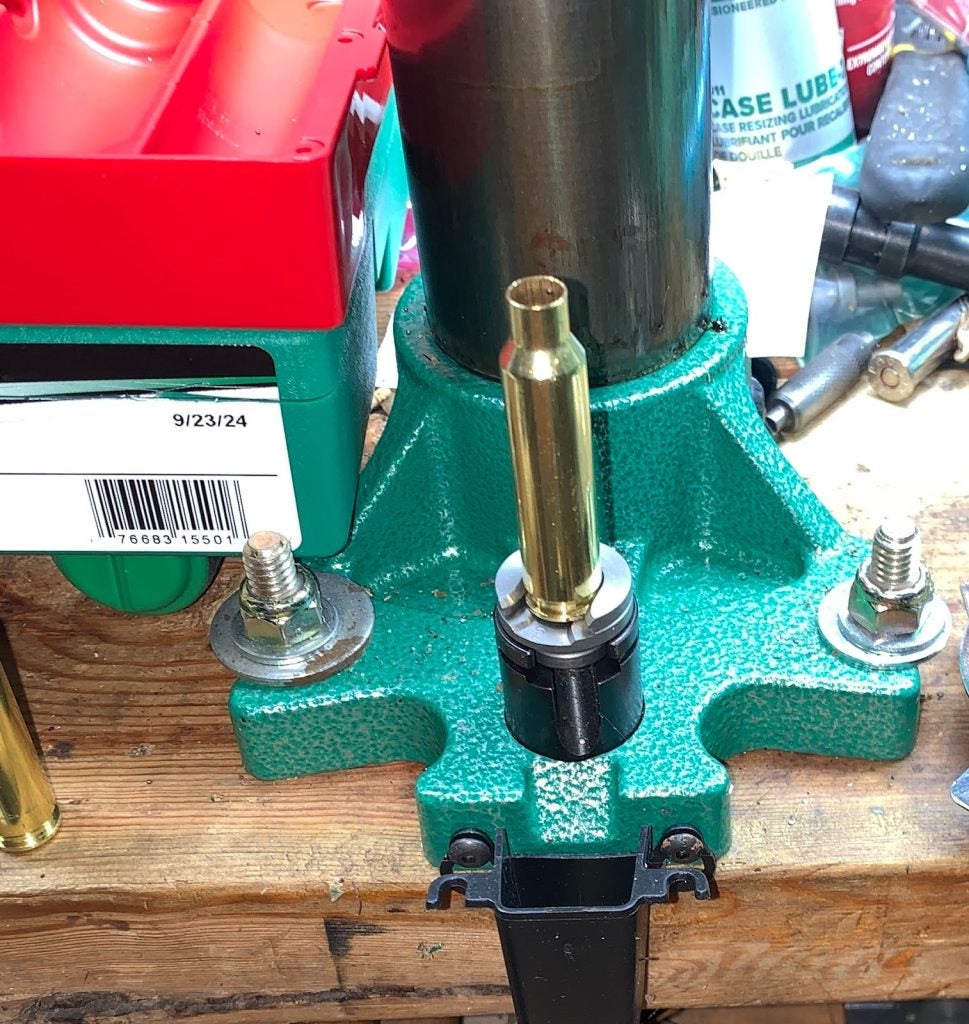
I am blessed to have different presses I could use. I have an RCBS Rock Chucker Supreme kit set up with a Summit press (pictured above) from the green company sitting next to it. Each has advantages. The Rock Chucker is the great-grandson of the RCBS Jr. press I bought in 1978, which still works. It is different in one way, in that it uses compound linkage to make resizing easy. A priming arm is built in.
The Summit is a different critter, as there is nothing below the bench level, which means you can mount it in the middle of your bench if space is a concern. I got the optional short lever, so it doesn’t interfere with the bench. Plus, its window seems a bit more “open” to my pudgy fingers than that of the Rock Chucker, but that could be me.
Powder Measure:
Again, I have choices here. For the ultimate in reloading precision, I’ll use my RCBS MatchMaster powder dispenser. This jewel has two drop tubes… one for normal reloading and one for match (precision) work. Not only is it faster than most precision dispensers, but it features .04-grain weight precision and a large touchscreen. It makes dispensing large charges of any type of powder fast and easy.
For “everyday” reloading, I like the UPM-3 Competition measure. This swinging-arm, rotor measure uses an adjustable micrometer chamber to adjust the meter. It is very precise and repeatable.
The Process
I will be looking to load hunting-quality ammo. I am not a 1000-yard competitor, but I still want the most precision my tools will give me, for deer at normal woods ranges. So, even though I’m not “benchrest” loading, I want to do the best job I can. I’m talking about maybe 1.5 MOA or something similar.
The actual reloading process is pretty simple, and I won’t go into great detail as it would be “preaching to the choir”, but after preparing your cases, here’s the drill…
- Measure your cases. Check your case length and make sure that it is within the maximum length given. That happens to be the same measurement for both of these calibers… 2.015 inches. Interesting.
- Lube your cases. I use spray lube, but I also use an old-fashioned lube pad – just don’t overdo either. Don’t forget to lube inside the case mouth so the expander ball slides over it easily.
- Resize and deprime. Run all of your cases through your number one die, and knock the spent primer out. At this point, you should make sure the primer pocket is clean and true… the Brass Boss can perform both of these functions. You should decide before moving your press handle if you are going to neck size or full-length resize your cases and adjust your sizing die accordingly. If you are shooting these in a bolt-action rifle, neck sizing will do, but I would recommend full-length sizing for semi-auto rifles.
- Reprime your cases. Whether you do this by hand or on the press is your call. Some like the “feel” that hand priming can offer, over the more mechanical feel that the press gives you. I’ve had good results either way.
- Charge the cases. However you do it, drop the correct powder charge into each case. Here is where a good loading block comes into its own. I find that the new MatchMaster Powder Funnel Kit, with its individualized caliber-correct adapters, works very well. Plus, powder doesn’t stick to it, as it’s aluminum. With each charge carefully weighed and dropped, you are ready for the next step.
- Bullet seating/crimping. Here’s where we turn all this brass into loaded, ready-to-shoot ammo.
How do you adjust the bullet seating die? If you are seating bullets of approximately the same style and weight as loaded ammo you already have, the quickest way to set your bullet seating die is to back the entire die, and the bullet seater stem out a few turns and place a loaded cartridge in the shell holder. Slowly raise it into the die, and screw the die down a turn at a time, and also the seater stem down until it contacts the bullet nose. Make sure you do not set the shoulder back when setting the crimp depth. Lightly tighten the die and stem, remove the loaded cartridge, and put a charged case in the shell holder. Then, stick a bullet in the case mouth and raise it up into the die, seating the bullet. Pull it out of the shellholder and measure the overall length. Compare the O.A.L. to what it should be… 2.825 inch for the .277, and 2.810 inch for the .308. As long as you are at or slightly below these figures, you should be good.
What if you are loading bullets that are very different than those factory loads you have? It’s a case of trial and error. You screw the die body and seating stem out a bit, place a case with a bullet in the mouth in the shell holder, and run it up into the die. You must keep adjusting the seating stem and die body until you get the bullet seated to the correct depth. Don’t worry about crimping it yet – see below. The main thing is to adjust the bullet seater stem to move the bullet into the case just far enough to achieve the overall length number.
You need to make sure the bullet does not touch the rifling when it is loaded from the magazine into the chamber… it needs a bit of free bore. (Again, this is not benchrest loading… some of these procedures can be different when striving for maximum precision. I’m looking for ammo that is not only functional, but also is reasonably accurate.)
What about crimping? That is the last stage before you examine each cartridge for a final visual inspection. Crimping can be done either after bullet seating, in one operation, or as a separate stage… It’s your call. If you like to crimp separately, you will (first) only seat the bullet to the correct depth, and (second) either screw your seater die down a turn or two or use a separate crimp die to lock the bullet into the case. I find that crimping as part of bullet seating works well for the types of reloading that I do. This way, I’m not constantly fiddling with screwing the seating die up and down. I set it once, and then all the cartridges are consistent with each other.
The Loads
I found .277 bullets at my local Academy Sports. I got a box of Hornady 130-grain SP Interlock, stock #2730. If I were to load mondo quantities of this caliber, I’d probably order them in bulk online, but for our purposes, one box will work.
These were the closest to the factory bullet weights that I had been testing, and they make excellent deer-zapper loads.
I was recently blessed to receive .308 bullets and a large quantity of 9mm bullets as well, from Raven Rocks Precision. I will describe the rifle bullets in more detail below.
I was also sent reloading dies from Lee Precision and RCBS. Hodgdon provided Winchester Sta-Ball Match, Hodgdon Varget, and Hodgdon CFE223 powders. Cases for the .277 that I kept from SIG ammo I bought, and .308 cases from loaded ammo that Black Hills Ammunition sent, rounded out the component needs.
Load data for the .308 is easy to find… the Hodgdon Load Data Center (link below) has lots of them. The .277 was a different story… I could find only one source of data for the powders I wanted to use. At least there was one… The cartridge is so new that much published data isn’t out there yet. Look for more in the future, as I believe this new cartridge will catch on in a big way.
Lee Precision’s Dies
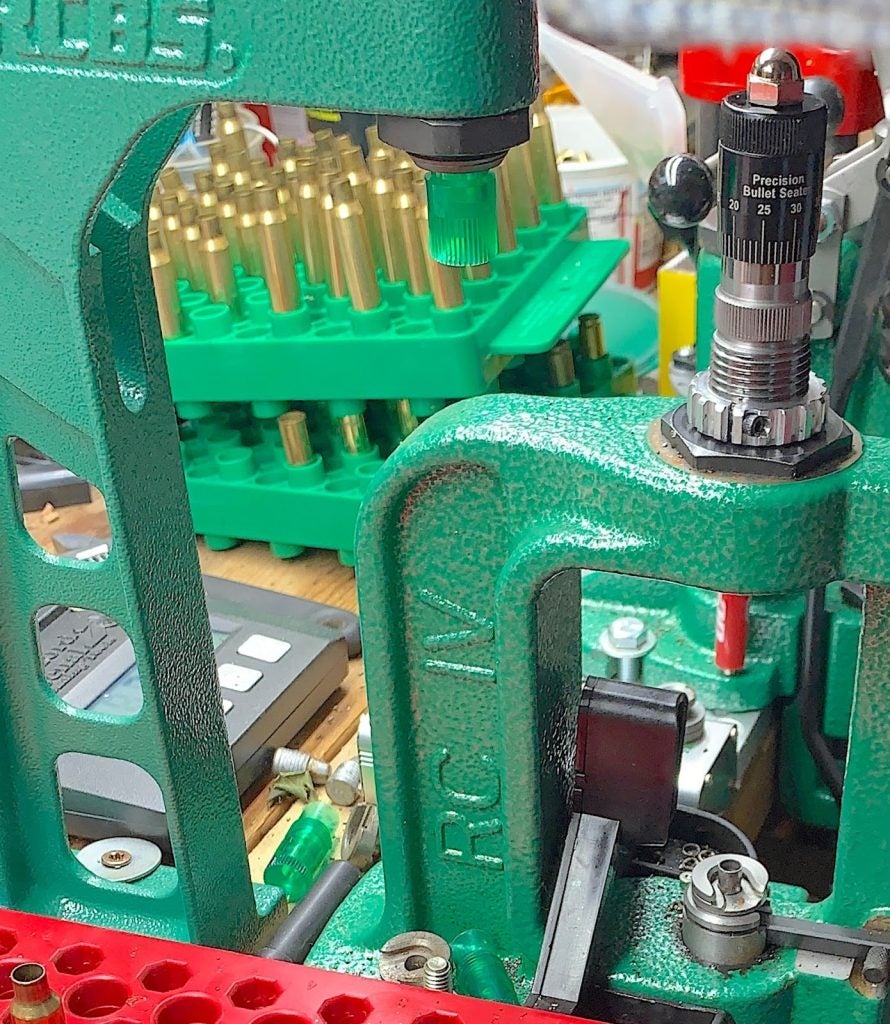
Lee has upped their game… note the micrometer bullet seating die.
I did source a set of dies from Lee Precision, and a thing of beauty, they are. I think I mentioned above that the seater die is a micrometer affair… very nice. As I just stated, Lee has upped their game considerably, and the micrometer die proves it.
For exactly $46.98 full list, you can buy a set of .277 SIG Fury dies that includes the micrometer seating die and a shell holder. That’s cheap, if you ask me. Even the box they sent them in was an upgrade over previous efforts. It was a hard plastic case with instructions and a nice, locking lid. I have used many different die sets over the years, and I own several, made by Lee, but these new ones really take the cake. They are first-rate. I realize that these dies may not work for long-distance or benchrest shooters, but for the type of reloading I do, they work very well.
Data and components are much easier to come by for the .308 than the .277. I went to the source, Hodgdon, and went to their load data center. That worked for the .308, but there was nothing for the .277. So, I bit the bullet (sorry) and joined XXReloading.com. For twenty bucks a year, you have access to loads that you might not normally find – like the .277. The loads seemed a bit on the light side, but they’re a safe place to start. I could only find one .277 caliber bullet, so I went with it. Bullets should be available, however, since you use .277 bullets to load the .270 Winchester. There just wasn’t a large variety locally.
For the .277, I created two loads each with the Sta-Ball Match and the Varget powders… a minimum and a maximum for each of them.
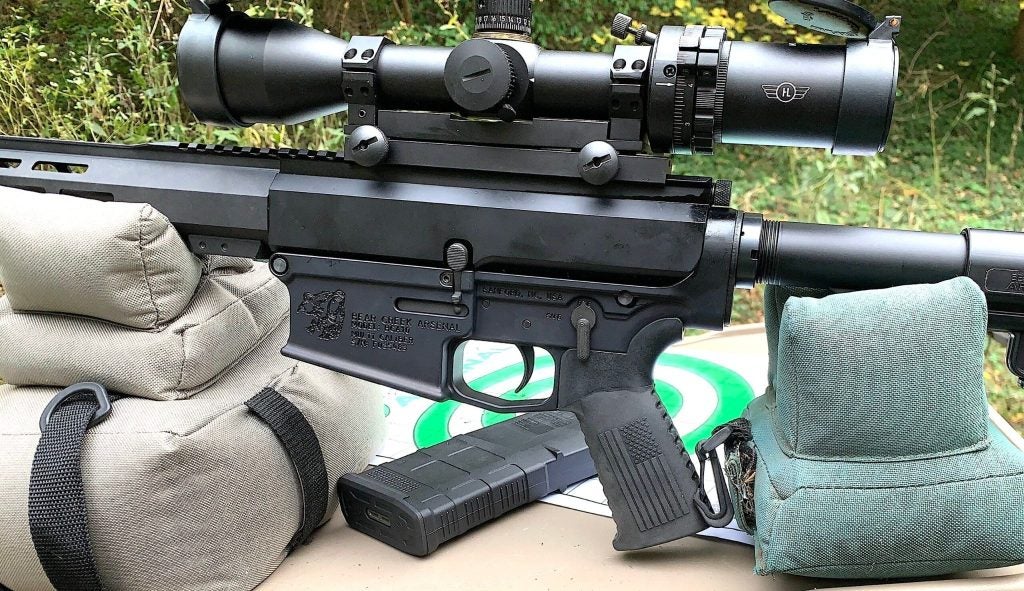
We did not have either of my chronographs when the .277 testing was done. In terms of shooting the 277, my friend who shot it for this review used a Bear Creek Arsenal AR with a 16-inch barrel. He was able to get a full 100 yards on his property. That BCA rifle did a really decent job for us. You can read all about this rifle here.
Here it is, with a top-end HiLux ART scope on it…
…and here is the Glenfield .308…
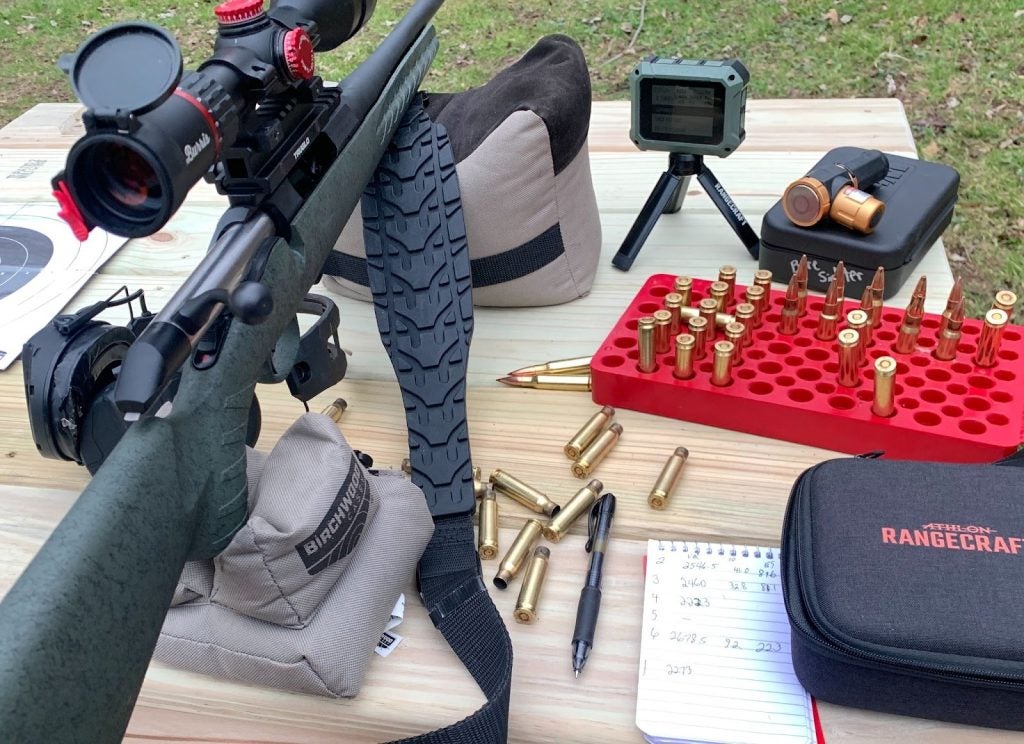
Here’s what we loaded for the .277:
| .277 SIG Fury, 130 gr. Hornady SP Interlock Bullet | ||
| Winchester StaBALL Match, min/max: | Grains: 38.9 |
Grains: 45.1 |
| Hodgdon Varget, min/max: | Grains: 34.6 |
Grains: 39.2 |
The .277 Take-Away
Looking at the targets, I found one that was more interesting than the others. This one was the best:
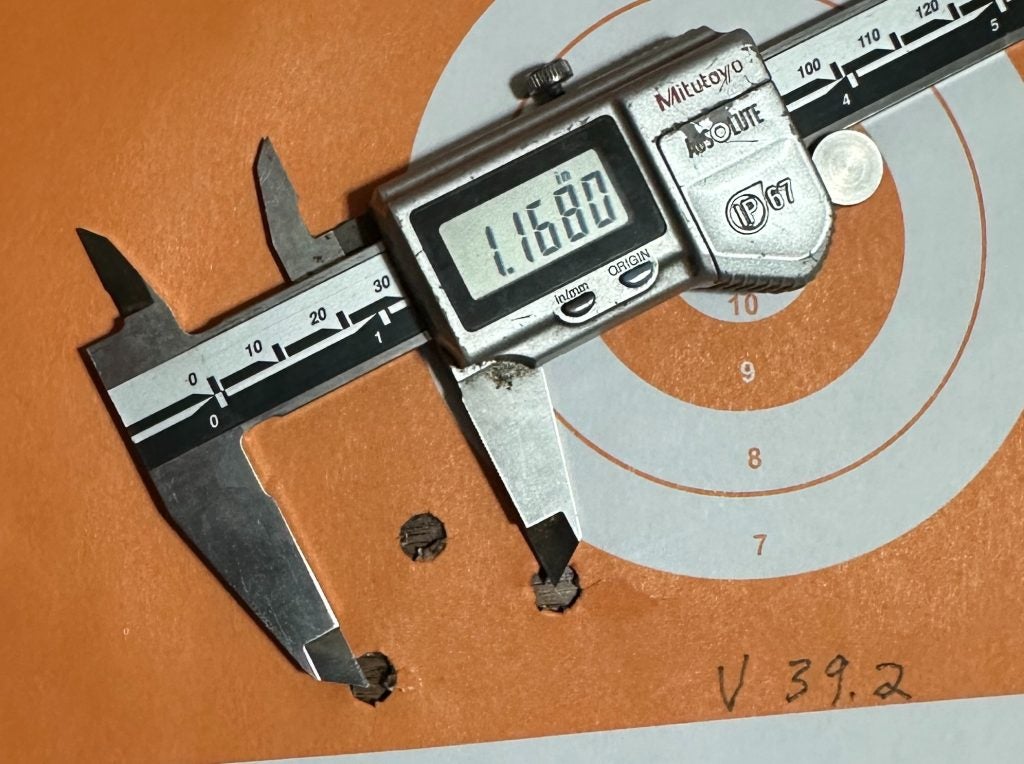
I think that, with a bit more experimentation, we could come up with a sub-MOA load.
Now, the .308…
I used the same two powders, plus added one more Hodgdon powder, CFE223. As for bullets, I mentioned above that I was sent 9mm bullets and three different .308 types by Raven Rocks Precision. Look for more on the 9mm bullets later. Now, we’ll look at the .308s.
RRP sent me a box of each of the following:
– Hornady 168-grain HPBT match;
– Nosler 168-grain HPBT Competition;
– Swiss P Defence 167-grain Styx Action HPBT
The first two, I’m familiar with. I had not heard of the Swiss bullets. I checked on them and found out that, unlike Swiss steak, they are actually made in Switzerland. Thun, to be exact. So we have both domestic and imported bullets to try.
As above, I loaded a few rounds each of all three powders, with a minimum and a maximum for each. I had to limit the loads I made… I would’ve loved to load all three, with all three powders, but I wanted to “cut to the chase”, so I used the Nosler bullet with the CFE223, the Hornady bullet with the Varget, and the Swiss bullet with the Sta-Ball. It was just the way the cookie crumbled. I found a few loads that were interesting, which is the point of reloading, after all.
I set targets up as far out as the downed trees would let me on my home range, right at 90 yards at this time, grabbed my Ruger Glenfield Model A .308, a Burris Fullfield 3-12×42 scope, and sat at my new, professionally-built heavy-duty wooden shooting bench. (I can get bluprints from my friend who made it if you’re interested).
Below, SD = standard deviation; ES = extreme spread
| Loads #1 & 2: Nosler Bullet, CFE223 Powder, min/max: | Grains: 41.0 |
Velocity: 2273 |
Grains: 45.0 |
Velocity: 2546 |
Comments: Both loads 1 and 2 bear further experimentation. They were fairly accurate. |
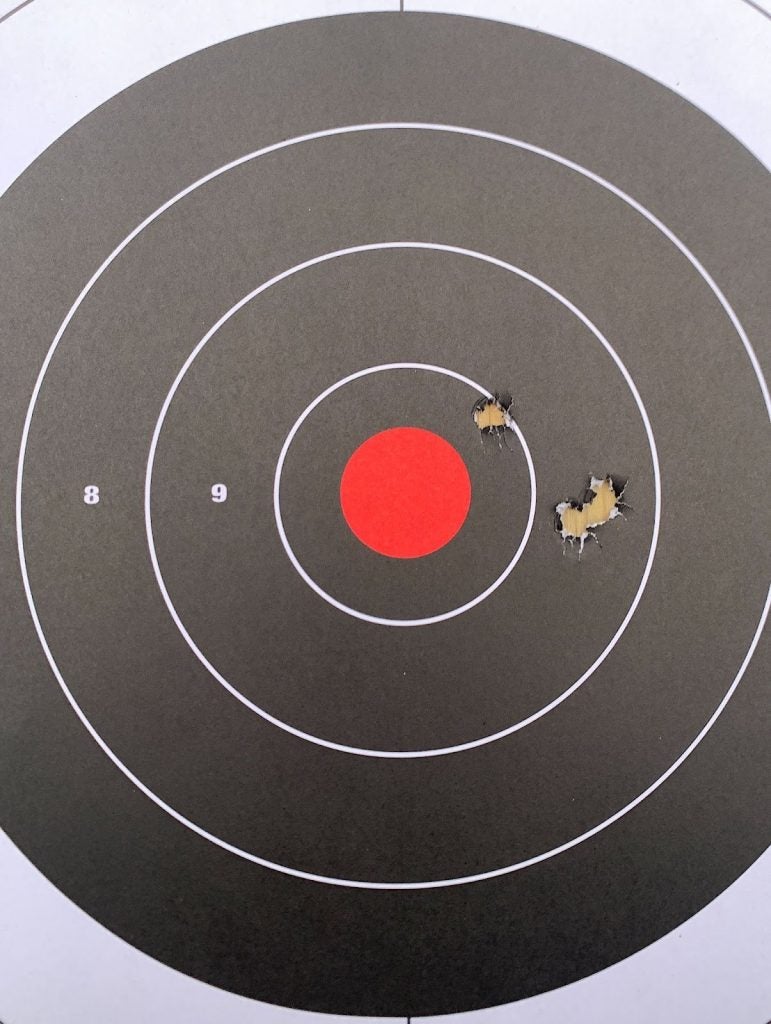
| Loads #3 & 4 : Hornady Bullet, Varget Powder,min/max: | Grains: 41.0 |
Velocity: 2460 |
Grains: 45.0 |
Velocity: Not recorded |
Comments: Load 3 bears further experimentation. Load 4 was not that great, so I moved on. |
| Loads #5 & 6:Swiss Bullet, Sta-Ball Match Powder,min/max: | Grains: 42.4 |
Velocity: Not recorded |
Grains: 46.4 |
Velocity: 2679 |
Comments: Load 5 was not good, but load 6 bears further experimentation. It had the lowest SD, 9.2, and ES, 22.3, of all six loads. |
Load 1

Load 2
Load 3

The .308 Take-Away
After reviewing the targets and the chrono data, we see three loads that warrant further experimentation among the six we tried. Of course, to be thorough, I would need to test each bullet with all three powders, rather than one bullet/one powder as we did here. At least we have a starting point for our search for an accurate load at a decent velocity. All four of the pictured loads shot into (at most) 1.5 inches.
Summing Up
First, know that this was not meant to be a “277-vs-308” article. Both calibers are excellent, and each is worth owning.
If you are looking for something new with potential military applications, the .277 SIG Fury is worth considering. Bullets, primers, and powders are easily sourced… the only hangup is a quick, easy case supply. You can buy either regular, all-brass cases or the bi-metal stainless/brass hybrid cases if you search for them. This cartridge is really two in one… all brass for lower-pressure practice, or bi-metal for your “atomic” loads. You can buy loaded ammo as cheaply as you can .223 or .308, if you want the all-brass case stuff. Or spring for the bi-metal cases and kick it up a notch. Hanging on to your cases from shooting loaded ammo is the quickest way to accumulate them for reloading. I think it will be worth it, as this cartridge is just getting started.
We are familiar with the .308… It’s been around a long time, and all components are readily available. Its military counterpart, the 7.62×51, ensures that brass will be around for a long time. The ol’ .308 is pretty versatile. I just used one bullet weight, but you could spend a week at your loading bench with all the bullet weights, powders, and combinations out there. The .308 is here to stay.
This was not meant to be a high-level technical article; it was intended to get you interested in reloading these fine calibers if you don’t already. So, I hope I’ve at least maybe lit a little reloading fire where these two calibers are concerned. Reloaders, let me know how you’re doing below!
Links To Items Used In This Article
