
The British were early adopters of revolvers, beginning with Colt Navy models in the percussion era and later embracing the various Adams and Webley designs of the late 19th century. When Great Britain entered World War I, it did so armed with the large Webley & Scott Mk VI chambered in .455 Webley. The revolver performed well, and was widely appreciated by the troops who carried it.
Despite its success and popularity, however, the British military concluded that the Mk VI was larger and heavier than necessary and began searching for a more compact sidearm. This effort ultimately led to the Webley Mk IV, though the path to its continued military service proved anything but straightforward.
TTAG took a look at the MK IV back in 2016, but I’ve been working with them for a couple decades myself and took another go at the topic here.
The Origins of the MK IV
During World War I, the British Army suffered heavy losses among its officers. They found that the large-caliber .455 pistols impeded the training of conscript replacements. In response, the British military began seeking a lighter, softer recoiling handgun in the 1920s. Webley & Scott quickly proposed the Mk IV, an evolution of their existing .38 caliber Mk III.
Despite a forty-year relationship with Webley, the British government instead adopted a similar revolver designed by Captain H.C. Boys of the Royal Small Arms Factory at Enfield. Although externally similar to the Webley, differences in its internal design were sufficient to justify its classification as a separate invention. Webley sued to recover development costs. While the claim was denied, the government awarded a lesser sum in recognition of Webley’s influence on the design.

The Enfield revolver was adopted as the Revolver, No. 2 Mk I in 1931. It remained the primary British service sidearm until World War II began in 1939. When Enfield production could not meet wartime demand, the government returned to Webley. They ordered the previously rejected Mk IV, with Webley ultimately producing 100,000 examples during the war.

MK IV Details
The Webley Mk IV was a double-action, top-break revolver with a six-shot cylinder. It was similar in concept to the larger .455 Mk VI. Opening the action by pressing a latch on the left side allowed the barrel to pivot downward. This automatically ejects all six spent cases at once and enables very fast reloads.

Wartime Mk IVs featured a 5-inch barrel with blade front and square-notch rear sights. They had improved internals for better lockup and reliability, black checkered Bakelite grips, and a lanyard ring.
The MK IV measured 10.5 inches in length and weighing 1.68 pounds. It was over half a pound lighter and notably smaller than the Mk VI. To speed wartime production, these revolvers received a rougher finish with visible machining marks. They were stamped “Wartime Finish” to distinguish them from Webley’s higher quality peacetime arms.

The .380/200 Cartridge, Revolver Mk I and II, AKA the .38/200
When Britain sought a new .38-caliber service cartridge, it adopted what was essentially the .38 S&W cartridge. It was loaded with a heavy 200-grain bullet rather than the lighter 146-grain American load, however. Designated the .380/200 or .38/200, it was essentially identical to the American .38 S&W Super Police load. It should not be confused with the longer, more powerful .38 Special.
This cartridge replaced the .455 Webley Mk II, which had been introduced in 1897 and used intermittently until 1939. The .455 Mk II fired a 265-grain lead round-nose bullet at about 600 fps for roughly 212 foot-pounds of energy.
By comparison, the .380/200 Mk I launched a 200-grain lead bullet at approximately 620 fps, producing 176 foot pounds. Close enough in perceived stopping power, while offering much lighter recoil. Testing on animals and cadavers supported its adoption for military service.
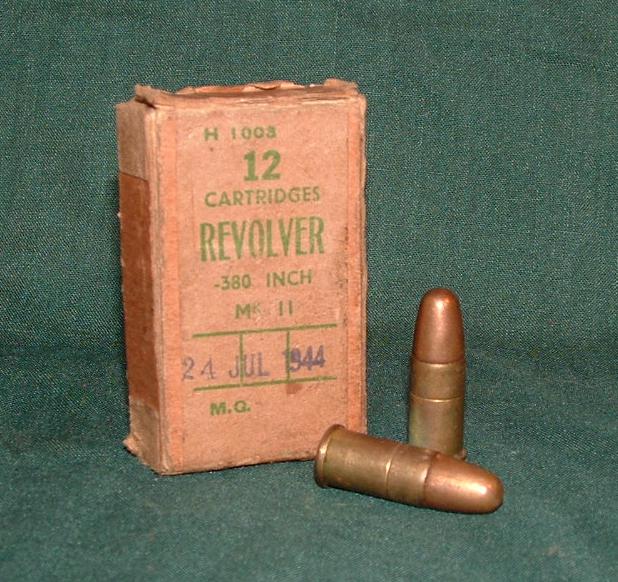
Concerns that the lead Mk I bullet might violate the Hague Convention led to the adoption of the .380/200 Mk II. It used a 178-grain full metal jacket bullet at around 650 fps for about 167 foot pounds of energy. Detailed data on the original Mk II loading is scarce. There is far less documentation available than for the earlier 200-grain version.
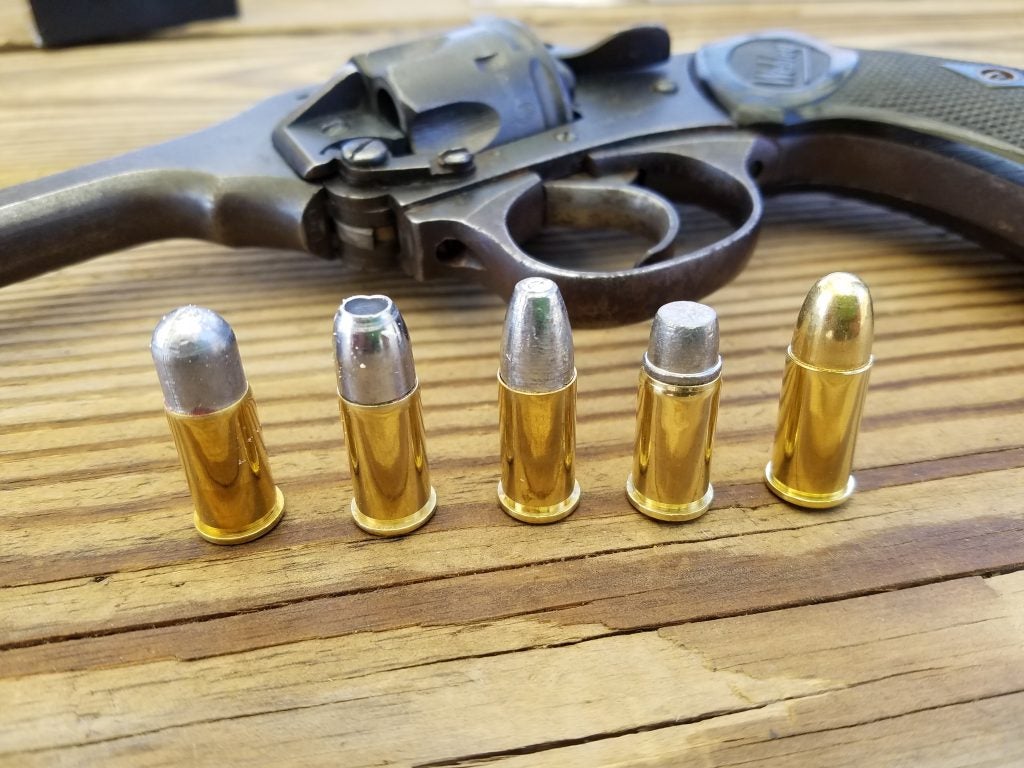
The.38/200 Cartridge Today
Finding correct .38/200 ammunition used to be tricky. While Webley revolvers will safely fire common American .38 S&W loads, the lighter 146 grain bullets typically impact 6 to 8 inches low at typical defensive distances. Still, for many years it was more common than .38/200 loads. Between availability, and usually being a little cheaper than .38/200 loads I have used a lot of it over the years. I have had some recent success finding correct loads though, and actually helped make one possible.
For years, the only proper weight load I could find came from Old West Scrounger. They offered a 200 grain .38/200 load sold in blue plastic boxes. It was listed at $34.95 per box of 50, though availability was sporadic. Currently I only see them listing a 160gr load, although it’s still only $34.95 a box.

Current .38/200 Offerings
I did discover Matt’s Bullets, which offers a 200-grain Webley Mk I / .38 Super Police load. They also used to list a a 180 grain .38 S&W hollow point. Although the latter is recommended for solid frame revolvers rather than Webleys or Enfields. I tested it anyway due to the scarcity of heavy .38 S&W loads. The 200gr loads are still listed at $39.99 per box of 50. Matt’s also offers bullets separately for handloaders.

A few years back I contacted Andy Steinel, of Steinel Ammunition Co. about making .38/200 loads as well. Andy makes a lot of ammo for obscure and hard to find military firearms. I thought he’d be a good choice for another ammo source. After some back and forth I convinced Andy that there were enough .38/200 Webley’s and S&W Victory models in the country to justify it.
He then set to work and developed a proper load. Andy’s .38/200 load uses a 200 grain lead bullet loaded in new Starline brass. It has a muzzle velocity of 540fps from a 3 inch barrel and hits to point of aim with my Webleys. It runs for $54.95 per box, and he generally has it in stock. If you have a .455 Webley, Andy has that covered too, as well as other oddballs like 8mm Nambu, 7.65 French, and 9mm Largo.
I also tested Buffalo Bore’s .38 S&W 125-grain hard cast flat-nose load. While much lighter than the original 200-grain military round, it’s traveling at 1,000 fps. It’s intended for defensive use. Buffalo Bore does rate this for Enfield and Webley revolvers, but not smaller American break top .38 S&W guns. It costs $38.32 per box of 20. To round out the test, I used some older Fiocchi .38 S&W ammunition loaded with traditional 145 grain lead round-nose bullets.

Range Time
I’ve used my Webleys a good bit over the years. I have two MK IV’s, a wartime model with a 5-inch barrel, and a postwar 4-inch police model from the early 1950s. The wartime gun, marked with the rough “Wartime Finish,” is in good condition today, though it didn’t start that way. When I acquired it, it was heavily rusted and nearly relegated to parts duty, but it cleaned up surprisingly well.
The coarse wartime finish proved forgiving, and after replacing a missing latch spring, it became a solid shooter. Its lockup is a bit loose though, and the cylinder shows some play. Based on the serial number, it was likely produced between 1943 and 1944 and probably saw wartime service.
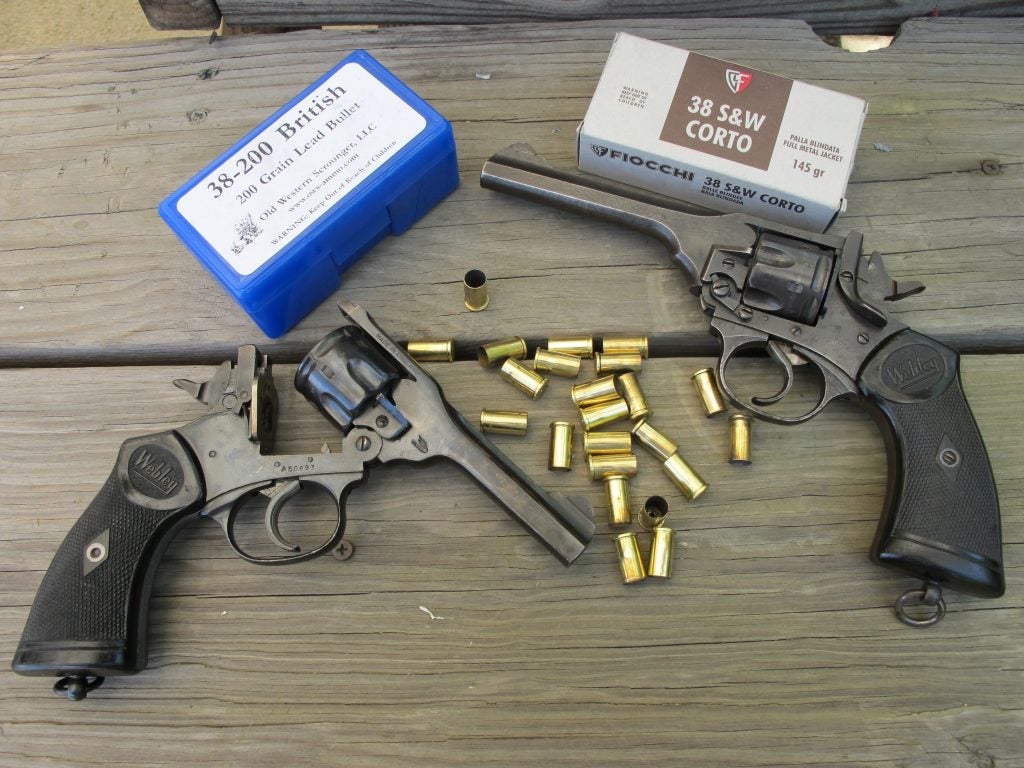
The postwar Mk IV, by contrast, appears unissued. Made between 1951 and 1953, it shows the high level of fit and finish Webley & Scott were known for. It has a deep blue finish, finely machined parts, and a tight, solid lockup. Aside from its shorter 4 inch barrel, typical of police guns, and its condition, it is mechanically identical to the wartime revolver.

I’ve always liked the look and handling of Webley revolvers. They are slightly lighter than comparable Smith & Wesson M&P models, such as the 5-inch Victory Model, which was also issued in .38/200. The Webley’s wider grip fits my hand better, points naturally, and the broad hammer spur makes single-action cocking easy. I also appreciate the top break system. While inherently weaker than a solid frame, it is efficient to reload. It has an elegant old-world charm to it.
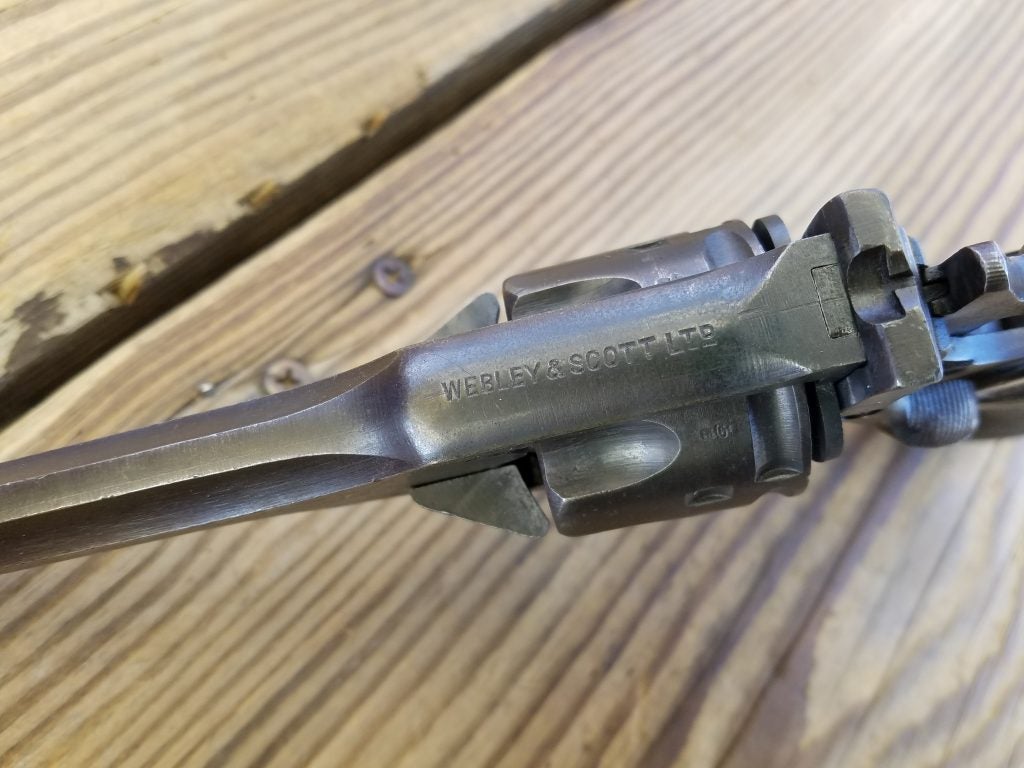
Single action trigger pull measured about 5 pounds on the wartime gun. It was just under 6 pounds on the postwar revolver. Double-action pull on both exceeded the 12-pound limit of my Lyman trigger gauge. The sights are typical of the era: a rounded front blade and a small rear notch. Recoil with standard 145-grain .38 S&W loads and the 200-grain .38/200 loads was very mild. Matt’s old 180-grain load had slightly more recoil. The Buffalo Bore 125-grain load was the stoutest, as expected, given its much higher velocity.

Accuracy
Accuracy favored the tighter postwar revolver. The wartime Mk IV produced 2-3 inch offhand groups on average at 15 yards. Though its looser lockup showed, especially with the 180-grain load, which opened groups to 4–5 inches. The postwar gun consistently delivered 1–2 inch groups at the same distance.
It handled all loads well, likely due to its tight lockup and excellent bore. Most accuracy testing was done single action. Although one of the best groups fired over various sessions was shot double action by my buddy Jim, showing that the heavy pull is manageable with focus.
For routine shooting, I used to stick with standard .38 S&W loads and adjust my hold accordingly. With proper factory .38/200 ammunition being available now, though, I try to keep a couple hundred rounds on hand since it’s really no harder to get than finding .38 S&W at this point. As long as you’re willing to mail order ammo at least.
Military Service and Beyond
Although originally intended as a substitute standard sidearm, the Webley Mk IV went on to enjoy a long and distinguished service life with the British military. It served from 1939 until being declared obsolete in 1956. The MK IV saw use not only in World War II, but also in the Malayan Emergency, the Korean War, and the Suez Crisis. Israel was another user of the MK IV.
Both wartime models from the British military, and later models ordered well into the late 1960’s direct from Webley & Scott. Webley’s .38 MK IV was also widely adopted by police forces in Great Britain and across the Commonwealth. They saw particularly heavy use in Hong Kong and with the Royal Singapore Police.

Webley produced the Mk IV until 1978, with approximately 500,000 revolvers manufactured. Examples can still be found in service in parts of the world today, and they are increasingly popular with collectors. Like most historical firearms, prices continue to rise. But Mk IVs currently tend to sell in the $400 to $600 range, depending on condition and region. While not inexpensive, they remain relatively affordable military revolvers, offering an interesting design and good shootability.
With readily available .38/200 ammunition you can now shoot these old British war horses without having to use Kentucky windage like the old days when only the lighter .38 S&W rounds could be found.

Webley MK IV Specifications
- Type: Top Break, Double Action Revolver
- Caliber: .38/200
- Overall length: 10.5 inches
- Barrel length: 5 inches
- Capacity: 6
- Weight: 1.68 pounds
- Muzzle Velocity: 620 fps (200gr Mk I loading)
- Manufacturing Dates: 1932-1978
- Total Manufactured: 500,000
- Manufacturer: Webley & Scott Ltd of Birmingham, England
