Images by the author
When you put a scope on a rifle, you have a specific need. There is a very clear purpose in your mind as to why you need one.
Whether you’re a hunter, target shooter, plinker, competitor, long-range shooter, or use a rifle for other purposes, there is at least one scope out there that will enable you to do your thing.
But what if you’re not really certain about why you want a scope, or you may want to kill two birds with one scope/stone? You know, buy a scope that can serve more than one purpose?
I’ll use myself as an example. It was only fairly recently that I got into rifles in a big way, so scopes were not big on the radar. I had been shooting handguns of all types since the late 1970s. I reloaded for them and cast bullets for those reloads. I really had no use for long guns… There was nothing wrong in owning them, of course… I just didn’t have a need. I wasn’t a part of that particular culture. Plus, you couldn’t hunt deer with centerfire rifles at that time in Indiana.
Things changed when two events occurred. The first event was when Indiana allowed centerfire rifles to be used during deer firearms season. Always before, muzzleloaders, handguns, and shotguns were kosher, but CF rifle calibers were not. I killed several deer with my long-barreled S&W 629 .44 magnum revolver and my mid-range handloads. Indiana finally got with the program several years back, and this year, they took things a step further when the state allowed centerfire rifles that shot bullets of at least .219” diameter to be used. That opened up a world of caliber options, not the least of which was the .223/5.56 mm. Whether good judgment or not – the jury’s still out on that – all those calibers are now legal.
The second event occurred at about the same time as Indiana’s rifle epiphany. I got more into gun writing. When I started out, I wrote mostly about handguns, but it wasn’t long before rifles began edging their way into my reviews. I got edja-ma-cated on them, and today, I own several. Some are of the AR persuasion, some are bolt action, and a couple are lever actions. I do not discriminate – I like them all.
The reason I say all that is to demonstrate my growing need for scopes. Red dot sights are fine for some uses, but if you want precision, magnified glass is the best. But as I said above, it took me a while to figure out just what type of scope I needed. I’ve learned a lot along the journey.
Uses For Scopes
I mentioned above some uses that shooters might have for scopes. Of course, I’m talking about civilian shooters… military uses are beyond the scope of this quick article, and are something I’m not qualified to comment on. Let’s look at a couple of different types of scopes, then try to imagine some uses they might be put to. We’ll look at a scope that uses the MRAD (or MILRAD, milliradian) system, and one that uses MOA (minute-of-angle). We’ll also compare first-focal plane (FFP) scopes with those that are built around the second-focal plane (SFP) system. In our example, the MRAD scope is also an FFP model, whereas the MOA scope uses SFP.
First, why MRAD and MOA, you ask? Those two systems are the main ways scopes slice the 360-degree target “pie”. Without going all geek, suffice it to say that MRAD uses a metric-based slicing of that pie. One click of MILRAD adjustment converts to approx. 3.6 inches at 100 yards (10 cm at 100 m). One MRAD subtends 1 meter at 1000 meters, or 1 inch at 1000 inches (about 27.8 yards). MRAD reticles typically offer fewer clicks, making it quicker and easier to dial the reticles in for longer ranges.
MOA divides the pie differently, based on fractions (⅛ MOA, ¼ MOA, ½ MOA, etc.). We have a system of angular measurement where basically one click of adjustment moves the reticle .25 inch at 100 yards. Four clicks move the point of impact (POI) about one inch at 100 yards. One MOA subtends about 1 inch at 100 yards (actually 1.047″). MRAD uses base-10 (0.1, 0.2, 0.3), while MOA uses fractions.
Compared with MRAD, each MOA click moves the POI a smaller distance, so it takes plenty of clicks to move your POI any very far. American civilian shooters tend to use MOA, while the military and much of the rest of the world will use MRAD.
So whether you need MRAD precision or not. I have one scope of each type to show you. I didn’t mount them on a rifle, as I wanted to just focus on the scopes. Plus, this article isn’t a rifle review, so let’s look at these scopes…
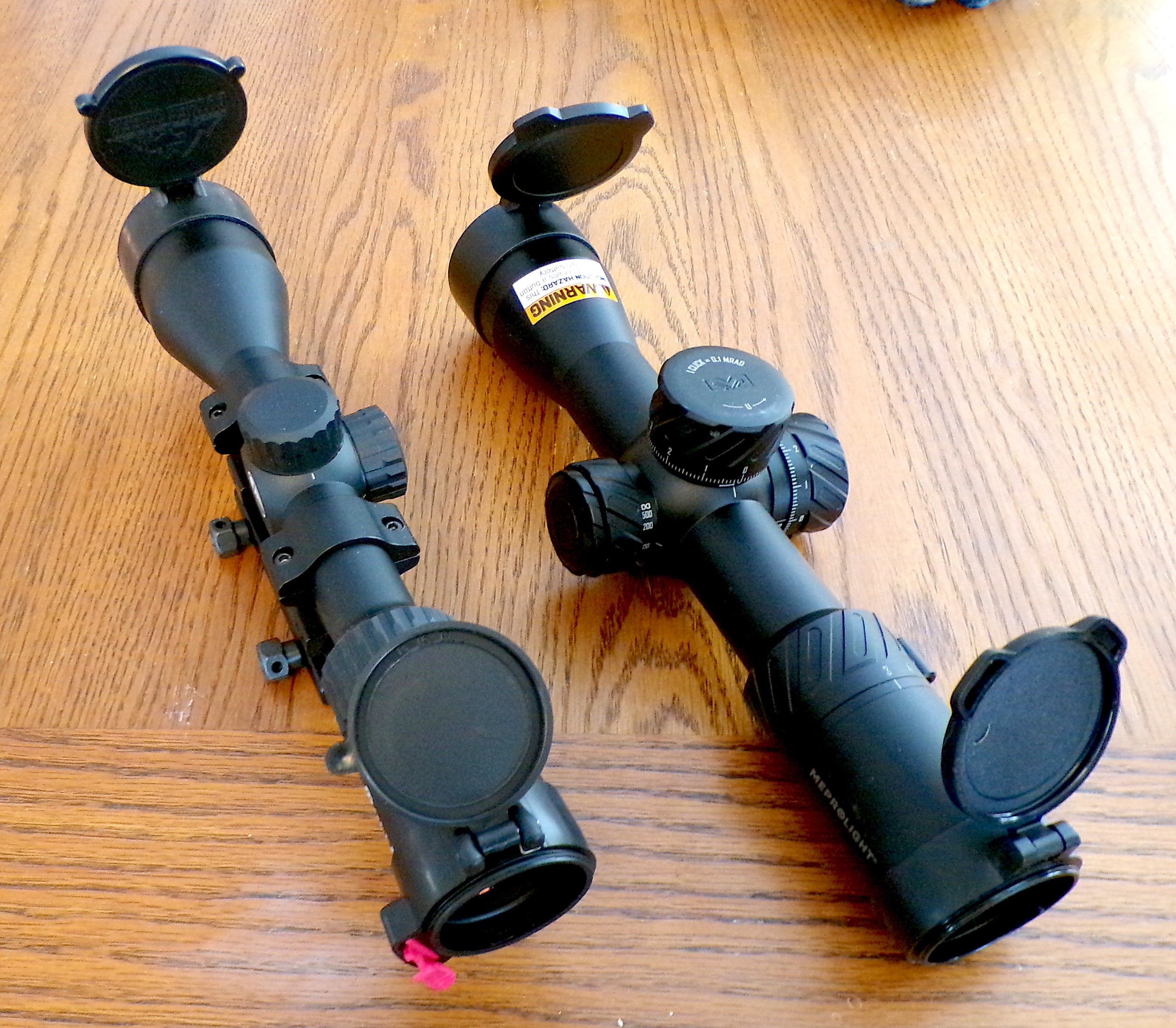
The MRAD Scope – Meprolight 3-18×44
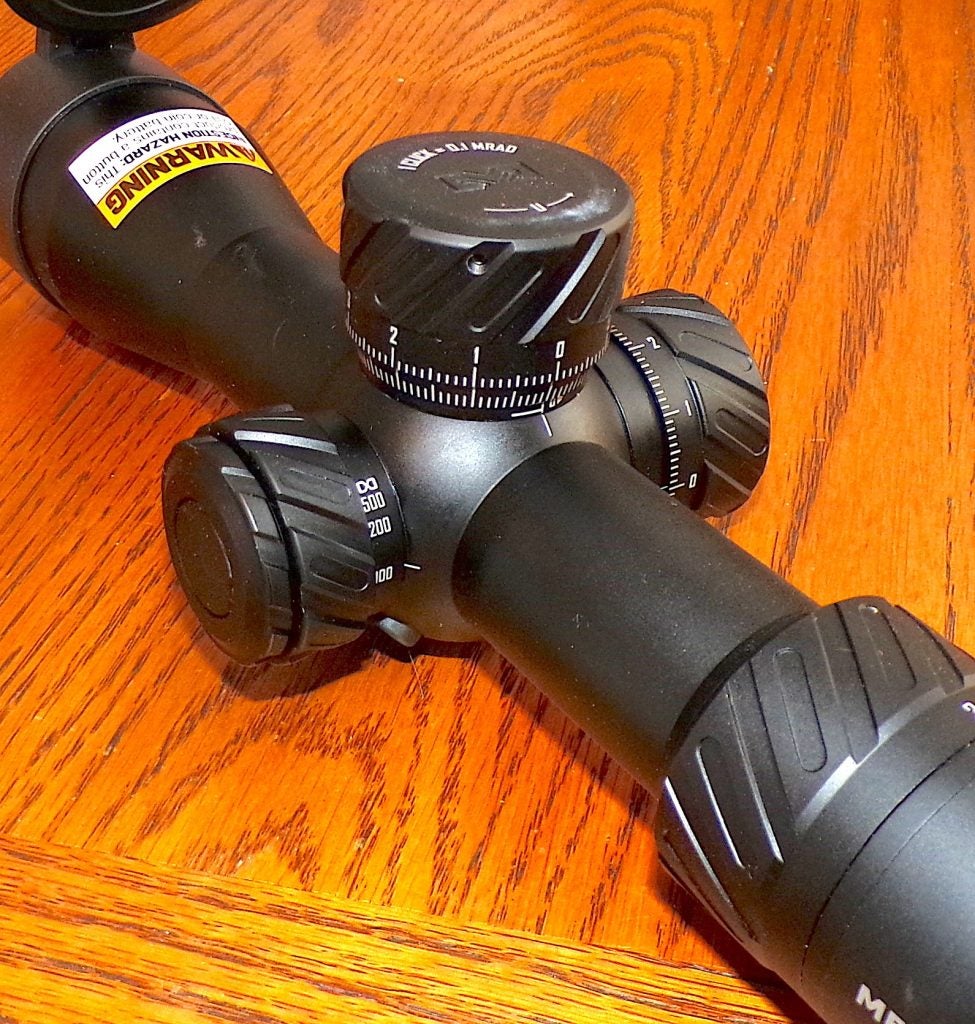
As an example of an MRAD model, I will use a Meprolight 3-18×44 scope. This scope is different from the second scope here in two major areas… first, it’s MRAD, as I said. Secondly, it’s an FFP scope. The reticle “grows” with the magnification.
This scope is a marvel of modern technology. It is parallax-adjustable from 30 yards to infinity. We’ve already mentioned its FFP capability, and the reticle can be illuminated via either a red or green light, with several intensities of each. This scope is no lightweight, at 28 ounces, and it has a chunky 34mm main tube. That helps with light transmission. The reticle is the M3 Mil Reticle, with (from the scope’s owner’s manual): 12 Mils of holdovers broken into .2 Mil increments for exact shot placement on the whole MIL lines and .5 mil dots on every half mil between the whole mil lines. 1 to 5 Mils of left and right wind holds allow adjustment for 20-30 mph winds with the most popular calibers out to 1,000 yards. Got that? The reticle is made for extreme precision.
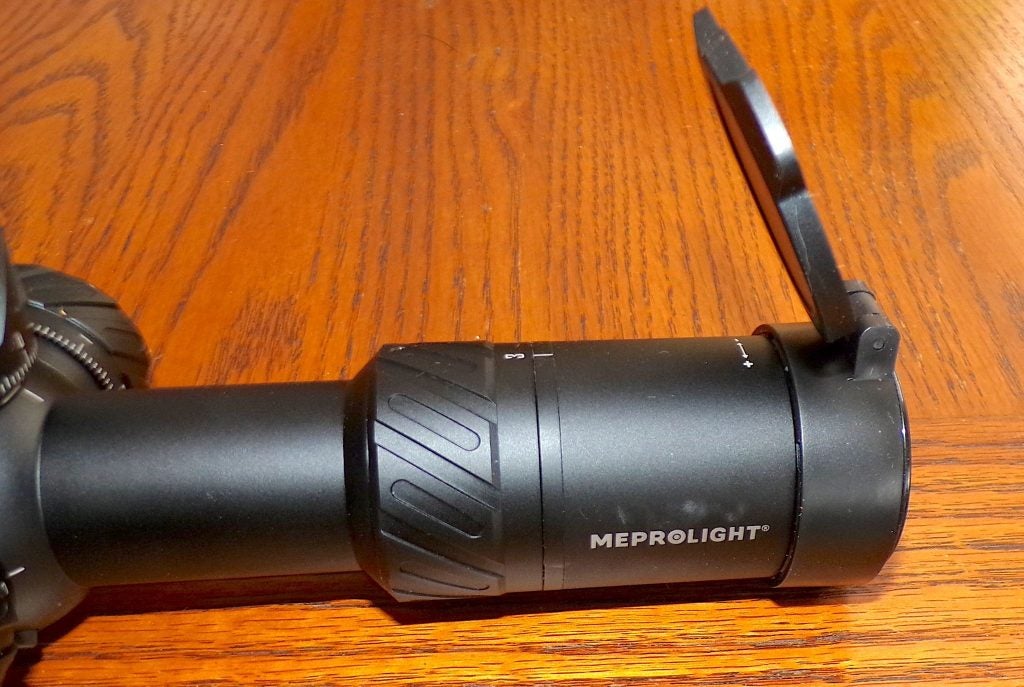
The specification list for this scope is lengthy. Also, it is definitely not the least expensive of the two, with an MSRP of $1799.99. But, if you need MRAD precision coupled with FFP capability, this scope bears looking into. It’s made by a company known for quality optics.
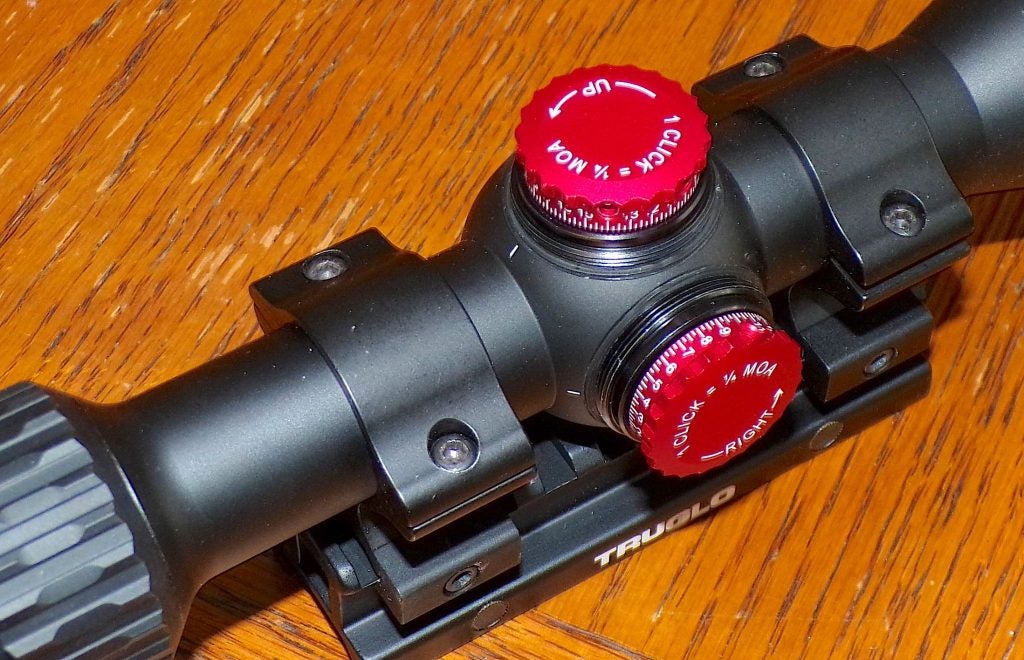
The MOA Scope – Burris Fullfield 3-12×42

If your needs don’t require the list of specifications that the above scope offers, you might consider this Fullfield scope. This year marks the 50th anniversary of the Fullfield line, and there are several scopes for you to consider. The one I have here is the 3-12×42 model.
This scope uses the MOA system, which will be familiar to American shooters. It is also an SFP model, where the reticle’s size is fixed and does not get larger with magnification.
It is a lot lighter than the FFP scope above – SFP scopes tend to be lighter than FFP ones, as first-focal plane scopes tend to be more heavy-duty than their SFP cousins. This scope is about 11 ounces lighter than the one above.

The field of view is large, and the scope is bright. This particular scope uses the Fullfield Ballistic E3 reticle, with BDC holdover hash marks, which allow the shooter to adjust hold at longer ranges other than where the scope was zeroed.
This scope is simpler to use than the MRAD scope above, but that’s typical of the breed. Many shooters don’t need the technical abilities of an MRAD scope, so MOA/SFP scopes like this one make sense.
So… What’s The Correct Scope For You?
My experiences may have applications for you. If you’ve ever searched for a scope but were discouraged by the zillion choices and prices you found, you’re not alone. Many shooters get confused, trying to figure out what would work best for their situation, only to put off deciding until later – and then they never do it, or they just plunk down cash for the first “bargain” scope they find.
We’ve looked at two different styles of scopes. One uses a system used by most of the world’s shooters, plus military and law enforcement units – MRAD. The other uses a system in place for decades here in the U.S., employed by American shooters and hunters – MOA.
Another variable to consider is the focal plane. FFP scopes have reticles that may be easier to see, but they tend to be more expensive. SFP scopes are very common and are usually a bit cheaper than FFP models.
You have to decide what you are going to use your scope for. Are you going to compete in long-range shooting competitions? If so, the MRAD system, with its fewer clicks, might be for you. How about hunting deer or similarly-sized critters at medium ranges? MOA should work for that.
If you simply want a scope to ventilate tin cans way out there, the MOA version should work. Here’s another angle… what if you like the familiarity of MOA, but want an FFP scope? No biggie… There are dozens of FFP scopes out there that use MOA.
If you want more info on affordable, long-range scopes, here is a good article by Shooting Times magazine.
I feel most shooters are familiar with SFP scopes, since there are many dozens of them for sale literally everywhere. Also, FFP scopes may not be top of mind due to their cost… here’s an interesting article on FFP scopes across price ranges, from about $300 to about $1500.
If you are reading this article, you are interested in the right scope for your needs, and I hope I’ve shed some light on the differences between MRAD/MOA and FFP/SFP scopes. Please let us know below what you ended up with!
Related Scope content on TTAG
